

Indonesia — Raja Ampat
Raf's Reef Brief
North Raja Ampat
Visited December 5-8th, 2025
Written May 8th, 2026
'North' Raja Ampat is our term for the vast collection of limestone islands & patch reefs cradled by Pulau Waigeo. Nestled between two powerful warm ocean currents from the Halmahera Sea and Dampier Strait, the area is home to a powerful and complex web of water exchanges between its islands. The result is a collection of exposed & protected coral reefs fueled by deep nutrient-rich upwellings.
This combination of geology, oceanography, and temperature is responsible for the explosion of underwater diversity and life that Raja Ampat is known for, and the North is no exception. Fields of hard corals like the columnar Isopora palifera & dense I. brueggemanni dominate exposed reefs, while a colorful array of massive Porites spp. and branching Acropora create lush sheltered coral gardens.

An exposed fore reef on an uninhabited coral island atoll.
Approximately 50km from the heart of tourism in Raja Ampat, this area still feels wild— mainly due to the fact there is not much to do here for the average tourist. Besides some local villages, beaches, and a manta cleaning station the majority of tourists here are only passing through to Wayag-Wayag or Aljui Bay above.
Consequently the lack of tourism has both saved and doomed this area. While the North's lack of tourist sewage has spared its corals from the 2024-2025 wave of coral mortality that devastated central Raja Ampat, the lack of tourists also means less local MPA enforcement & more overfishing, mining, and coral predation that have historically devastated reefs in this area.

One of many rubble slopes, most likely from disease, Drupella, or dynamite fishing
North Raja Ampat's corals are what I originally expected when visiting the region. While there are vast stretches of long ago blast-fished Acropora rubble, there are a number of outstanding high cover areas with (relatively) minimal negative health indicators. And unlike the rest of our time in Raja Ampat, this location was one of only two (out of five) to not to feature significant amounts of fluorescence or bleaching among the hard corals. However, unmonitored commercial fishing, predator explosions, homestay development, and potential mining pose signifigant and immediate threats to the area.
I would recommend the North's hard corals for diving/snorkeling and conservation/research, but only once liveaboard and homestay sewage output is regulated across the region. This location needs to be kept as one of a few clear standouts when it comes to the surviving hard coral reefs of Raja Ampat.
Walkthroughs of the Hostile North
Surveying the reefs of North Raja was a significant challenge logistically & physically. Without operating on a liveaboard, we had no access to scuba tanks or large vessels, though the price of fuel in the province is what truly limited our travel distance. Additionally, local risks like storms, unpredictable currents, and the local population of crocodiles (one of which was associated with the body of a deceased tourist in 2015) further refined our site selection. And as if that wasn't enough, our target sites of Pulau Wofoh & Aljui Bay further north were closed to tourists by angry locals in protest of the government revoking mining permits in the area. Yikes...
Nonetheless, we reviewed 9 sites from December 5th to 8th for hard coral health, whose walkthroughs and data can be viewed below. Some sites may have their names, coordinates, and maps censored if the corals are deemed too vulnerable to be shared with the public.
Sites Table of Contents

Yef Kabu Northeast
December 5

A restored Acropora dominated fore reef on Yef Kabu
The exposed fringing reef on the northside of Yef Kabu consists of decent, mixed cover across the fore reef and reef flat. Currents can range from strong to light and visibility varies dramatically. This reef is quite near a cluster of new homestays and has a corresponding amount of disease & nutrient indicators. There is a small, successful Acropora restoration zone in the middle of the site.
Personally, given this was my first time in the water in Raja Ampat, I was a bit underwhelmed by the lack of significant hard coral cover. It didn't help that the visibility was relatively low or that there were a bunch of stinging-somethings in the water. However looking back, I do think it was above average when compared to the other 50+ sites we visited across the region.
Yef Kabu Northeast Site Walkthrough
Yef Kabu Northeast Site Data
Site Two
December 5, 6

Acropora colonies utterly dominate the large outer reef flat at Site Two
Site Two is a semi-exposed fringing reef on a coral island. The exposed side of the fore reef consists of sparse, mixed cover with a damaged reef flat. Meanwhile the semi-protected side has excellent hard coral cover, particularly Acropora, over a large area on the fore reef and outer reef flat. This healthy cover extends into the backreef in some places, while in others it contains significant negative health indicators. Currents were strong to non-existent and visibility generally turbid.
This site was a total surprise, and the cover truly lived up to the reputation of Raja Ampat— so much so we double dipped it. Unfortunately, the rapid & recent proliferation of several homestays near this area may have been the reason we swam through dried floating grey-brown clumps that I can only describe as 'probably human feces'. I am still in denial but my partner is adamant that we swam through human sewage carried by the tides. Whatever, I was blown away by the cover at this site. Worth it.
Site Two Site Walkthrough
Site Two Site Data
Site Three
December 6

Adapated to absorb wave energy, Isopora & Acropora thrive in the reef crest at Site Three
The exposed fringing reef on the south side of Site Three consists of a steeply sloping fore reef, shallow reef crest, and prominent back reef. Hard cover coral dominates in all zones and is fairly high until the east end where strong currents give way to a soft coral & sand covered fore reef. Currents range from very strong to light and visibility is usually 7m+. Minimal negative indicators present.
Despite a bit of fear of the crocodiles the area is infamous for, I did quite enjoy the coral cover here. Though to be fair, anywhere with an I. brueggemanni back reef like this one would do the trick.
Site Three Site Walkthrough
Site Three Site Data
Site Four
December 6

Two species of Isopora, I. palifera & I. brueggemanni, compete for space in a high flow reef flat
Site Four consists of two adjacent fore reefs, one steep & exposed, and the other semi-protected & gradual. Behind the reef crest, there is a large back reef. All areas have high Isopora dominant hard coral cover. Currents range from strong to non-existent with 7m+ visibility. There was significant destabilization on the steep fore reef & notable macro/turf algae on the back reef, possibly due to strong exposure and runoff from a nearby settlement respectively.
While the steep I. palifera fore reef was quite disappointing, the adjacent I. brueggemanni slope & back reef/inner reef flat really blew me away. Best of all was the surprise giant clam garden consisting of 60+ individuals. I still don't know who put them here, but wow. Large numbers of giant clams like this are very rare in Indonesia due to local fishing.
Site Four Site Walkthrough
Site Four Site Data
Site Five
December 6
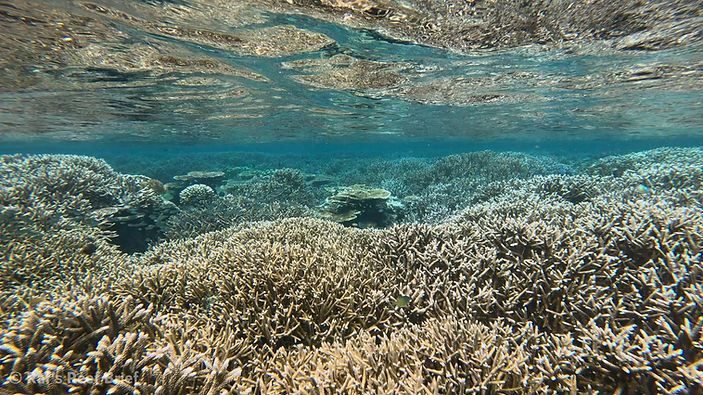
Dense, shallow Acropora reign over the outer reef flat at Site Five
The semi-protected platform reef at Site Five consists of gradually sloping, sandy fore reefs surrounding a reef flat & back reef with very variable percentage Acropora hard coral cover. Currents are mild to non-existent and visibility is high. There was a mild outbreak of COTS present, which may explain the decrease in cover in some areas.
Personally, I didn't think much of this site due to the large areas of degraded cover and the depressing COTS presence. If it weren't for the few areas of still-intact cover, or the 3 epaulette sharks that joined us for our snorkel, I would have written this site off as a bust.
Site Five Site Walkthrough
Site Five Site Data
Site Six
December 7

A colony of Acropora indonesia, the king of table corals, grows at Site Six
Site Six consists of a long stretch of gradually sloping fore reef, a large portion of which is protected, culminating in sand plateaus at ~7m. Coral cover on certain sections of the fore reef and plateau have very high hard coral cover, while others are long gone rubble fields smothered in soft corals and macro-algae. There is one steeply sloping section of fore reef that is fully exposed. Currents are mild and visibility high.
While the initial rubble fields were depressing, the healthier areas of the reef were fantastic. Like at Site Two, the Acropora diversity here really surprised me. I could spend all day snorkeling shallows like these.
Site Six Site Walkthrough
Site Six Site Data
Site Seven
December 8

While not diverse in species, Site Seven contained at least 5 phenotypes of I. brueggemanni
Site Seven is a long stretch of very exposed, gradually sloping fore reef from ~3m to 10m+. There seems to be a plateau (or a more gradual reef slope) beyond that depth. While the reef crest and reef flat consist only of long gone rubble, possibly from strong wave exposure or dynamite fishing by a nearby village, the slope is dominated by a monospecific field of I. brueggemanni at all depths for over a kilometer. Some ares are totally degraded with lots of drupella & macroalgae while other have extremely high cover. Currents were strong to mild and visibility was 10m+.
Wow. Ignore the fact that around half of this reef is degraded... Just the fact that some of a kilometer-long monotypic reef still exists is fascinating! We haven't seen a reef this dominated by I. brueggemanni (one of my favorite corals, btw) since Tubbataha. Imagine the genetics at this site, how does a field like this even form? Even with the damage, this site was a dream come true!
Site Seven Site Walkthrough
Site Seven Site Data
Yef Mo North
December 8

One of several Acropora colonies in Yef Mo's semi-protected north fore reef
The northern reef at Yef Mo begins with a very steep & short exposed fore reef beneath an intertidal reef crest. This fore reef becomes more gradual as it curves around to form a semi-protected bay. The bottom of this bay is made up of a plateau (or a more gradual slope) that stays ~10m deep, which contains a majority of the coral cover in the site, though degraded with ruts, macroalgae, and soft coral. The fore reef varies in condition greatly. Yef Mo is an uninhabited coral atoll island with strong to mild currents and moderate visibility.
In my personal opinion, we were not able to properly map Yef Mo North without scuba equipment, due to the deep nature of the plateau. That being said, I was not impressed by the fore reef or reef crest, especially after some of the other sites here. Ending with the find of harvested giant clams wasn't particularly inspiring either.
Yef Mo North Site Walkthrough
Yef Mo North Site Data
Site Nine
December 8

A giant colony of Acropora florida stands out among a cluster of columnar Isopora on the fore reef of Site Nine
Site Nine consists of an exposed fore reef that begins with a gradual terrace & shallow slope before dropping off into a wall at 5-7m deep. The area is continuously dominated by hard corals with only a few areas of low to no cover. The less exposed areas are dominated by massive Porites, while the areas with strong flow are dominated by very high cover of Isopora palifera, where there is a minor COTS outbreak. Currents range from very strong to mild and visibility was very high.
Sites like this are what this website is all about — an unmapped hard coral reef with extremely high coral cover and very few negative indicators. The impeccable visibility and golden hour didn't hurt either.
Site Nine Site Walkthrough
Site Nine Site Data
How to Visit the Corals of North Raja
Like with many of the locations on this website, and in Indonesia in particular, visiting the hard corals of Raja Ampat is quite the challenge. The usual woes of getting to the region, planning one's logistics, bringing the right gear, and having the in-water skills required are tough here. Finding sustainable dive & snorkel operators who will accompany you to the specific sites & depths with the highest coral cover can be even harder.
Lets focus in on that last sentence— sustainable. It's no secret that the dive & snorkel travel industries (and to a lesser extant, all travel in general) have an undeniable negative impact on hard coral environments. This is especially applicable in Raja Ampat, where largely unrestricted tourism has caused near-irreversible harm via sewage, mechanical damage, and development.
Absolutely no one who isn't contributing to the conservation of these reefs in a significant way should be visiting if their visit are causing measurable harm to the integrity of the ecosystem present. This is something I take very seriously which will be reflected in the recommendations below. If sustainable means are not present, this section will be unavailable indefinitely.

Oops... We're still working on
the guide for this location!
Receive a notification & be the first to read this guide once published. Plus, get access weekly coral insights.
Site Index — Quick Access
DISCLAIMER: This blog post does not constitute scholarly research, nor is it partnered with or associated with any scientific research, institutions, journals, publications, or scholars. All observations are qualitative and informal, observed during standard recreational activities without accordance with scientific norms, methods, accreditation, training, or procedures. These observations are presented only as blog posts intended for environmental enthusiasts on Rafsreefbrief.com. All blogs and observations are not submitted to nor meant for use by any scientific publications or purposes, and are not meant to support any scientific truth, conclusion, profit, or technology. Observations are only valid at time of occurrence. All opinions expressed are our own. We are not liable for any damages or losses resulting from the use ore reliance of information contained on Rafsreefbrief.com or its media accounts. Seriously people, this is just an environmental-travel hobby & blog, nothing more!