

Indonesia — Raja Ampat
Raf's Reef Brief
Fam Islands
Visited December 10-16th, 2025
Written May 18th, 2026
The Fam Islands are a collection of limestone & coral islands located in the center of Raja Ampat. The big islands, like Pianeymo to the north and Fam underneath, are inhabited and defined by drastic karst cliffs with thin fringing reefs. Nestled between two powerful warm ocean currents from the westward Halmahera Sea and easterly Dampier Strait, this archipelago is home to a powerful and complex web of water exchanges between its islands. The result is a collection of exposed & protected coral reefs fueled by deep nutrient-rich upwellings and juxtaposed against dramatic rock formations.
This combination of geology, oceanography, and temperature is responsible for the explosion of underwater diversity and life that all of Raja Ampat is known for, and the Fam Islands are no exception. Wherever the steep karst cliffs offer space to grow, there are fields of hard corals like foliose Montipora hodgsoni, branching Acropora microphthalma, & dense Isopora brueggemanni providing shelter for an incredible amount of fish life.

Large matrixes of Montipora foliosa like this one are a hallmark of Fam Islands' coral cover
Despite 25km of sea between the Fam Islands and the core of tourism in Raja Ampat, this location is already very busy— and worse, damaged. Scores of day trips & liveaboards alike arrive in Pianeymo every day, due to the famous viewpoint at Geosite Pianeymo and the famous dive sites at Melissa's Garden & Pulau Rufas. Meanwhile, many homestays now dot the coastline of the archipelago's various islands.
It is evident that this volume of tourism is unstainable for the local hard coral cover, as almost every site presented significant active mortality and nutrient indicators. This is most likely due to high concentration of human sewage in the water released locally from the aforementioned liveaboards & homestays, as well sewage carried by currents from other regions of Raja Ampat, which greatly increases coral susceptibility to climate change among other stressors.

One of many recently destroyed Montipora colonies, this one at the famous Melissa's Garden
Honestly, the Fam Islands broke my heart. Since I was a child I dreamed of visiting site's like Melissa's Garden & Pulau Rufas, to the degree which they became the most anticipated travel destinations of my entire life. And while there are still many great hard coral environments in this archipelago, the sheer amount of recent damage & negative indicators shocked me to my core. From the famous Melissa's Garden to the remote Pulau Jar, no site was spared.
I would still recommend the Fam Island's hard corals for diving/snorkeling and conservation/research, but only once liveaboard and homestay sewage output is regulated across the region. This location is actively degrading, and will continue to degrade if we don't relieve nutrient loading pressures.
Walkthroughs of the Fam Islands
Surveying the reefs of the Fam islands was a significant challenge logistically & physically. We stayed at one of the only homestays with access to a compressor for scuba diving, though it wasn't consistently available and site selection was shared with other guests. This meant that we surveyed a majority of sites via snorkeling rather than diving. Additionally the high local cost of fuel, lack of power, freshwater shortages, and storms posed significant problems. Not to mention the constant fear of crocodiles (a drone shot of two saltwater crocodiles is literally, I kid you not, the SECOND image result when you search Pianeymo on Google).
Nonetheless, we reviewed 16 sites from December 10th to 16th for hard coral health, whose walkthroughs and data can be viewed below. Some sites may have their names, coordinates, and maps censored if the corals are deemed too vulnerable to be shared with the public.
Sites Table of Contents

Gloria Homestay House Reef
December 10

Various tabular & branching species of Acropora compete for life in the shallows of Gloria Homestay
Gloria Homestay's adjacent fringing reef consists of semi-exposed gradually sloping terraces bordered by a sandy beach on one side and a steeply sloping upper fore reef on the other. Live hard coral cover ranges from totally devastated to somewhat intact but is usually the former. Negative indicators like disease & cyanobacteria are always present, likely due to the open bottom septic tank right on the beach. Fish life is very high. Currents range from mild to very strong and visibility is always high.
To be honest, this site crushed me. As our first site in the Fam Islands and after just having seen the 'variation' in reef health up north, I was truly hoping that this region would be better. Sadly, it was worse, and is the perfect example of how unchecked waste can wreck coral cover from the inside out.
Gloria House Reef Site Walkthrough
Gloria House Reef Site Data
Melissa's Garden
December 10, 11, 14

A diver drifts over the endless fields of branching Acropora in the world-famous Melissa's Garden
Melissa's Garden is a large offshore platform reef with three limestone towers that breach the surface near the center. A majority of the reef flat is only 4-6m deep and surrounded by a gradually sloping, sandy fore reef to ~28m. Fish biomass was very high. Cover is usually very highly dominated by Acropora and Montipora, though there are many Porites bommies and tabular Acropora. Some areas were destabilized, actively dying, or long-gone and negative indicators of every kind are everywhere. Currents were moderate to strong, and visibility low to high.
Oh, Melissa's Garden. Where do I even start? This is possibly the most famous coral reef in the world due to its fish biomass and hard coral cover... and consequently was the most anticipated dive site of my entire life. I used to watch videos of this reef during primary school and spent countless hours trying to determine the state of it before my eventual visit. We dove it 3 times in total and were able to explore the whole thing. This brief will be long and detailed, likely beyond what this reef deserves compared to other healthier, more intact spots—but it was my white whale, so be ready to read the most in depth overview of Melissa's Garden on the internet.
My feelings about this site should also explain why I was so disappointed. There is indeed a LOT of great cover here, but there is an equal number of very recent coral mortality and negative indicators. Melissa's is no longer the "healthiest coral reef in the world" as the dive industry has peddled for years—outstanding in some spots, yes, but overall not pristine enough to be worthy of its misleading fame. The fish life was the highest I've ever seen though.
Melissa's Garden Day 1 Site Walkthrough
Melissa's Garden Day 2 Site Walkthrough
Melissa's Garden Day 3 Site Walkthrough
Melissa's Garden Site Data
Pulau Rufas East
December 11, 15

Echinopora lamellosa & several species of Acropora dominate the eastern shallows of Pulau Rufas
The famous dive site at Pulau Rufas is the fringing reef that begins on its southern corner and continues to the entrance of a lagoon about halfway up its eastern side. The reef flats here begin beneath limestone cliff-overhangs and are of variable width, bordered at first by steep walls which eventually become gently sloping fore reefs. Cover is usually partially bleached, destabilized, or long-gone and mostly branching Acropora or foliose Montipora & Echinopora. Currents are strong at the south and mild elsewhere and visibility is high until the lagoon entrance. The site is very busy with snorkelers and divers, and there are two homestays on the island.
With the reputation of Pulau Rufas as a must-see dive site, I was quite disappointed with the number of foliose colonies that were in shambles—even if the intact ones were quite beautiful. However, after snorkeling the west side of the island (which we will talk about here in Site Ten), I can't help but feel that this was the lucky side of Rufas when it comes to surviving 2025... tragic.
Pulau Rufas East Site Walkthrough
Pulau Rufas East Site Data
Site Four
December 11

A small colony of Acropora bifaria outcompetes neighboring Porites cylindrica for sunlight in the shallows of Site Four
Site Four consists of a ~150m long east-to-west submerged "peninsula" of fringing reef that makes up the northern barrier around a small deep bay. This peninsula is connected to more fringing reef shielding the east side of the bay, which we will explore in Site Thirteen. It does not connect with the western or southern portions of fringing reef around the bay, which we will cover in Site Fifteen. The peninsula's topography varies greatly in topography with the shallowest points along its length ranging from 3 to 12m+ deep, and the fore reef ranges from steep walls to gradual sandy slopes. Cover is highly variable, with several sections of both excellent intact hard coral cover and devastated rubble. Mild bleaching and nutrient indicators are both present, currents were non-existent, and visibility was moderate to high.
Overall, this site was an unexpected gem—most of all because of the humongous intact Montipora hodsgoni colonies (spoiler alert, this was the largest intact colony of Montipora that we saw in all of Raja Ampat). The huge schools of fusiliers didn't hurt either. What did suck was the navigation on this site, but more on that below.
Site Four Site Walkthrough
Site Four Site Data
Site Five
December 12
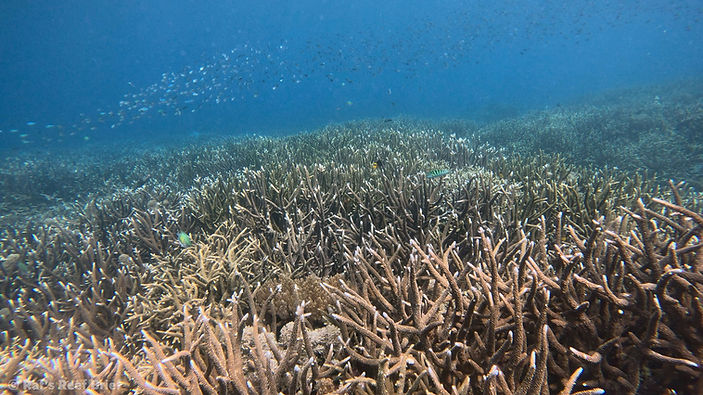
Diverse thickets of branching Acropora reign over the terrace at Site Five
Nicknamed something very gimmicky by dive boats, the southwestern fringing reef at Site Five sits along a semi-exposed high flow bay. The bay is lined by a beach that gives way to a sandy slope before the reef begins on a very wide, gradually sloping terrace that averages at least 4-8m deep. Cover is generally low with large rubble fields (some very recent) overgrown by soft corals, though some sections still exhibit intact Acropora cover. Far from human settlements but visited by liveaboards. Currents ranged from very strong to strong and visibility fluctuated between very high & low.
Sadly, after recent mortality, it seems that the name has become false advertising—the overall state of the reef here was simply depressing. If I hadn't promised to keep this specific site anonymous, I would have shared the site name simply in the hope that it would convince sewage-dumping liveaboards that it's not worth visiting anymore.
Site Five Site Walkthrough
Site Five Site Data
Site Six
December 12

Countless chromis school above dense, colorful Acropora colonies at Site Six
Site Six is a spur and groove formation reef on the south side of a coral island. It is bordered by a beach and low cover reef crest which gives way to a sandy slope before the actual coral cover begins at about 5m+ deep on the upper fore reef. The live hard coral cover is very high & robust and dominated by Acropora & Montipora, except for the Isopora brueggemanni-dominated south side, where disease (I think) is ravaging the colonies. No nearby settlements. Currents were mild and visibility was very high.
We hopped into the water here on gut instinct alone, and what a surprise! The coral cover was significantly better than at Site Five. If it weren't for a time restriction, I would have really liked to survey the full extent of this fringing reef. Sadly, due to the aforementioned disease wrecking the cover on the south side of the site, I may not get the chance before it's too late.
Site Six Site Walkthrough
Site Six Site Data
Site Seven
December 12

The high flow, exposed reef flat at Site Seven forces various species of Acropora & Isopora to adapt via dense, competitive structures
Site Seven consists of a coral island with a very large current-swept sandy reef flat to the west and a long fringing reef along the south, consisting of a prominent reef crest & sloping upper fore reef. Coral cover varies dramatically with some areas devastated & others with insanely high cover. Generally, the site is dominated by Isopora brueggemanni slopes with plenty of negative indicators, including many Drupella & cyanobacteria. Currents ranged from very strong to mild and visibility fluctuated between high & non-existent.
I have very, very fond memories of Site Seven. Yes, a majority of the site was in shambles (or worse...), but the magnificent, colorful, dense cover towards the end just blew my mind. Sites like this cement the fact that Isopora brueggemanni is hands-down my favorite species! I would return in a heartbeat.
Site Seven Site Walkthrough
Site Seven Site Data
Site Eight
December 13

Columnar colonies of Isopora palifera grow over a slope of congeneric I. brueggemanni at the end of Site Eight
The exposed fringing reef on the east side of Site Eight consists of a kilometer-long fringing reef bordered by alternating limestone cliffs, bays, and beaches. The site varies in depth and width but is generally either a deep terrace above a vertical wall or a sloping fore reef atop a steep slope. Coral cover is equally varied in quality & diversity, with some areas containing fields of intact branching Acropora & Isopora and other areas falling apart & coated in cyanobacteria. Currents were moderate and visibility ranged from poor to very high.
After painstakingly locating this site from an obscure unnamed YouTube video, I had strong expectations of this site; and while the mortality and nutrient indicators depressed me for the first half (and revealed how much healthier this site used to be), the rest of the site did not disappoint. The remaining coral cover was so exciting that we came back to further survey this coastline in Site Eleven, which was even better!
Site Eight Site Walkthrough
Site Eight Site Data
Piaynemo Lagoon
December 13

The well sheltered yet clear Piaynemo Lagoon is an ideal habitat for fragile foliose corals like Montipora
The Piaynemo Lagoon is a large, very deep banana-shaped bay on the east side of southeast Piaynemo. This site is characterized by a thin fringing reef adjacent to overhung limestone cliffs, whose sloping upper fore reefs plummet vertically into the abyss after only a handful of meters in depth & width. The live coral cover waxes and wanes without any major negative indicators but is generally scrappy and diverse. Currents were non-existent & visibility was always high.
I'm going to be honest: we only spent 20 minutes at this site (due to both a fear of crocodiles & some intense tummy troubles), so I'll reserve any negative judgement until I can revisit more thoroughly. Regardless, it was awesome to see the diversity present in such a unique environment.
Piaynemo Lagoon Site Walkthrough
Piaynemo Lagoon Site Data
Pulau Rufas West
December 15

Diverse arrays of Acroporids thrive in the high flow shallows on the west side of Pulau Rufas
Site Ten is the rarely visited, wide & semi-exposed fringing reef on the west side of Pulau Rufas. The reef consists of a gradual sloping terrace, which stretches 20 to 200m wide from the reef crest to the steeper upper fore reef, and is bordered by limestone cliffs & a short beach to its east. Hard coral cover is almost entirely obliterated (and often smothered by soft corals), save for a few live sections of branching Acropora & massive Galaxea fascicularis or Porites spp. Significant portions of the mortality are very recent, especially in the shallows. There are two homestays nearby. Currents range from mild to strong and visibility is usually high but can be non-existent near the wavy beach.
Despite being very excited to check out this reef after eyeing it during Site Three, I ended it utterly disappointed. The remaining sections of live cover to the north & in the shallows were respectable, but the obviously recent mass destruction here just broke my heart. Nonetheless, I did like that the site still had a lot of biomass—the black tip sharks were well appreciated!
Pulau Rufas West Site Walkthrough
Pulau Rufas West Site Data
Site Eleven
December 15

Green I. brueggemanni and cream Porites cylindrica form dense thickets due to the high flow at Site Eleven
Site Eleven is a further exploration of the fringing reef we explored in Site Eight, which begins with the same general topography described previously and ends with a major directional turn & a large exposed cape. The cape features a terraced fore reef that is deeper, wider, and higher in cover than anything seen in Site Eight—though the majority of Site Eleven is relatively higher in diversity & cover as well. Negative indicators are still present, such as cyanobacteria, disease, and moderate bleaching. Currents were moderate to very strong & visibility ranged from poor to very high.
Having ended Site Eight earlier than I would have liked, I was very grateful that we were able to return and enjoy the wonderful hard coral cover here. There is no feeling like flying in the current over fields of branching Acropora and Isopora... I could spend the rest of my life there.
Site Eleven Site Walkthrough
Site Eleven Site Data
Piaynemo West
December 15

The wavy bay at Piaynemo West hosts several giant coral colonies like this large mound of Gardineroseris planulata
Piaynemo West consists of a semi-protected bay with cliffs to the north, a beach to the east, and a shallow channel to the south. The bay itself is a sandy slope with a 1m deep reef crest close to shore and a 7m deep upper fore reef along its western edge. Cover is varied with devastated Isopora brueggemanni rubble on the upper fore reef, mixed massive colonies in the sandy slope, & mostly intact Acroporids in the shallows. Significant amounts of cyanobacteria, drupella, and garbage were present despite no adjacent settlements. Currents were mild (though wavy) & visibility was moderate to low.
I still have mixed feelings on this site. While my expectations were low (and confirmed via the devastated Isopora fields), the truly giant colonies here still gave me a lot of hope, and I would revisit again just to measure them. But next time, I'm going to do a better job confirming there are no crocodiles in the area before getting in the water...
Piaynemo West Site Walkthrough
Piaynemo West Site Data
Site Thirteen
December 16

Competition with the fast growing Echinopora horrida forces a Physogyra lichtensteini to take on an unusual columnar growth form
Site Thirteen is a ~100m wide square of semi-exposed shallow fringing reef at the north corner of a limestone island. Its western side makes up the east side of the bay we explored in Site Four & slightly overlaps with area 4a. The reef has a small karst island in its center and is generally flat between 2-4m deep, surrounded by a slightly deeper upper fore reef that culminates in steep slopes. While there is one small zone of exceptional mixed hard coral cover, most of the site is absolutely devastated with recent extreme mortality similar to Site Ten. Currents were moderate & visibility ranged from moderate to high.
This site was pretty depressing. Even with the amount of coral cover still present, the extent of mortality across this site was hard to ignore.
Site Thirteen Site Walkthrough
Site Thirteen Site Data
Site Fourteen
December 16

Dense thickets of Acropora dominate the shallow fore reef in Site Fourteen
Site Fourteen is a long stretch of semi-exposed fringing reef on the south side of an island. Generally, the topography consists of a 3-5m deep fringing upper fore reef with a gradual sandy slope below and a shallow, very wide (10m+) sandy reef flat above. There are two wide, prominent terraces on the fore reef about 5m deep, at the beginning and middle of the site respectively. The fore reef & reef flat constantly varied between dense Acropora and long dead sandy rubble but did not seem to feature much active degradation, though significant fluorescence and mild bleaching was present. Currents were light to nonexistent and visibility was generally moderate.
Despite the thermal stress & old rubble, the live cover here was beautiful, diverse, & dense. The Psammocora corallith field on one of the terraces made this a site to remember.
Site Fourteen Site Walkthrough
Site Fourteen Site Data
Site Fifteen
December 16

The protected slope at Site Fifteen is an ideal habitat for fragile branching Montipora
Part of the same fringing reef as Sites Four & Thirteen, Site Fifteen encompasses an exposed, steeply sloping fore reef with a shallow terrace to the west and the rest of the bay not described in Sites Four or Thirteen to the east (the west and south sides of said bay). The topography throughout the site remains the same until the middle of the bay, which contains a more gradual sandy slope. Coral cover waxes and wanes throughout the site but is usually high & dominated by Isopora brueggemanni. There are popular human settlements nearby and as a result many nutrient indicators were found. Currents were moderate to non-existent and visibility was generally high.
After the very variable cover of Site Four and the devastated cover at Site Thirteen, I expected Site Fifteen to be damaged as well. However, while far from perfect, the cover here was quite plentiful. You'd be hard pressed to try and find a site dominated by Isopora brueggemanni that I don't enjoy.
Site Fifteen Site Walkthrough
Site Fifteen Site Data
Site Sixteen
December 16

Ruddy fusiliers (Pterocaesio pisang) school along an Acropora domianted fore reef
Site Sixteen consists of a continuous south-to-north exposed fringing reef lined by tall limestone cliffs. The jagged coastline here forms three thin bays each 100-300m long, with the southernmost being the largest with a shallow reef crest. The rest of the site is made up of fairly wide 2-4m deep terraces atop a short sloping upper fore reef that drops into a steep wall. Coral condition fluctuates between intact branching or tabling Acropora & devastated rubble, sometimes smothered by soft corals. Disease, cyanobacteria, & mild bleaching were all notably present, and the site exhibited moderate to strong currents and high visibility.
We snorkeled Site Sixteen via two separate drops along the same coastline but condensed it into one site for your reading pleasure. While the best areas here were excellent, the fact that they made up a minority of the overall degraded benthic cover was quite disappointing. Fighting sweeping currents here didn't exactly help either.
Site Sixteen Site Walkthrough
Site Sixteen Site Data
How to Visit the Corals of the Fam Islands
Like with many of the locations on this website, and in Indonesia in particular, visiting the hard corals of Raja Ampat is quite the challenge. The usual woes of getting to the region, planning one's logistics, bringing the right gear, and having the in-water skills required are tough here. Finding sustainable dive & snorkel operators who will accompany you to the specific sites & depths with the highest coral cover can be even harder.
Lets focus in on that last sentence— sustainable. It's no secret that the dive & snorkel travel industries (and to a lesser extant, all travel in general) have an undeniable negative impact on hard coral environments. This is especially applicable in Raja Ampat, where largely unrestricted tourism has caused near-irreversible harm via sewage, mechanical damage, and development.
Absolutely no one who isn't contributing to the conservation of these reefs in a significant way should be visiting if their visit are causing measurable harm to the integrity of the ecosystem present. This is something I take very seriously which will be reflected in the recommendations below. If sustainable means are not present, this section will be unavailable indefinitely.

Oops... We're still working on
the guide for this location!
Receive a notification & be the first to read this guide once published. Plus, get access weekly coral insights.
DISCLAIMER: This blog post does not constitute scholarly research, nor is it partnered with or associated with any scientific research, institutions, journals, publications, or scholars. All observations are qualitative and informal, observed during standard recreational activities without accordance with scientific norms, methods, accreditation, training, or procedures. These observations are presented only as blog posts intended for environmental enthusiasts on Rafsreefbrief.com. All blogs and observations are not submitted to nor meant for use by any scientific publications or purposes, and are not meant to support any scientific truth, conclusion, profit, or technology. Observations are only valid at time of occurrence. All opinions expressed are our own. We are not liable for any damages or losses resulting from the use ore reliance of information contained on Rafsreefbrief.com or its media accounts. Seriously people, this is just an environmental-travel hobby & blog, nothing more!